Traces
Trace listing, detail views, JSON export, bulk deletion and request-log exclusion rules are
provided by the native_observability core module. The core module is a hard dependency of
every install tier (RAW, DASHBOARD, INTEGRATIONS). Enable it directly with
drush en native_observability -y, or install any preset (no:preset:raw,
no:preset:dashboard, no:preset:integrations), which pulls it in automatically.
Routes
| Route | Path | Permission |
|---|---|---|
native_observability.traces |
/admin/reports/native-observability |
view native observability traces |
native_observability.trace_view |
/admin/reports/native-observability/trace/{id} |
view native observability traces |
native_observability.trace_view_by_request_id |
/admin/reports/native-observability/trace/request/{request_id} |
access native observability |
native_observability.trace_export |
/admin/reports/native-observability/trace/{id}/export |
view native observability traces |
native_observability.traces_delete_all |
/admin/reports/native-observability/traces/delete-all |
delete all native observability traces |
native_observability.request_log_exclusion_list |
/admin/config/development/native-observability/exclusions |
administer native observability exclusions |
native_observability.request_log_exclusion_add |
/admin/config/development/native-observability/exclusions/add |
administer native observability exclusions |
native_observability.request_log_exclusion_edit |
/admin/config/development/native-observability/exclusions/{id}/edit |
administer native observability exclusions |
native_observability.request_log_exclusion_delete |
/admin/config/development/native-observability/exclusions/{id}/delete |
administer native observability exclusions |
Note that trace_view_by_request_id only requires access native observability, a lower bar
than trace_view, which requires view native observability traces. Grant permissions
accordingly if you link to traces by request ID from outside the traces list.
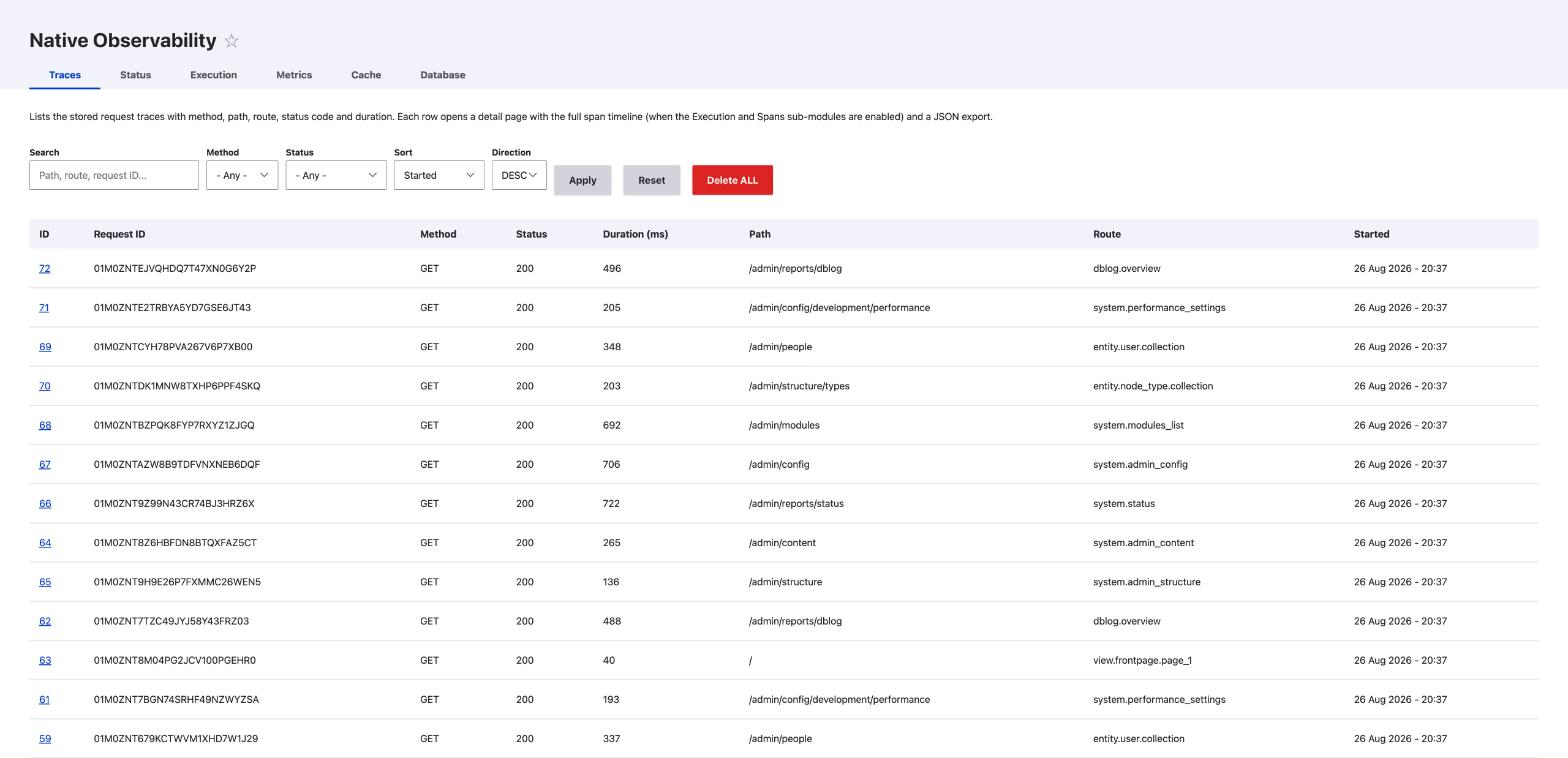
Trace list
Open /admin/reports/native-observability. The page renders a filterable, sortable, paginated
table built by TraceListController::list(). Filters live in the query string and are applied
through TraceStorageInterface::search():
search: free-text search across the columns the storage backend indexes.status_code: exact HTTP status code.min_duration_ms/max_duration_ms: duration bounds.sort/direction: sort column (started_atby default) and direction (DESCby default).
Each row links the trace ID to the detail page. The filters form also exposes a Delete all
action, visible only to users with delete all native observability traces.
Trace detail view
Click a trace ID, or open /admin/reports/native-observability/trace/{id} directly. The page
shows request metadata (request ID, method, path, route, status code, duration, start/end
timestamps, user ID, client IP) and the stored JSON payload, pretty-printed when it parses as
valid JSON.
If the payload contains a parent_request_id (an AJAX or sub-request correlated to a parent
request), the page adds a link to that parent trace via
native_observability.trace_view_by_request_id.
To look up a trace by its correlation ID instead of its numeric primary key, use
/admin/reports/native-observability/trace/request/{request_id}. This resolves the trace
through TraceStorageInterface::loadByRequestId() and reuses the same detail view.
JSON export
From the detail page, or directly at /admin/reports/native-observability/trace/{id}/export,
download the trace as a JSON file. The response uses the stored payload when present; otherwise
it falls back to a minimal JSON object built from the trace's core columns. The filename is
trace_<request_id>.json, with any character outside [A-Za-z0-9_-] replaced by _.
Deleting all traces
/admin/reports/native-observability/traces/delete-all is a confirmation form
(TraceDeleteAllConfirmForm) gated by delete all native observability traces. Submitting it:
- Counts and deletes every row via
TraceStorageInterface::deleteAll(). - Dispatches
NativeObservabilityEvents::TRACES_DELETEDwith the deleted count, so submodules (spans, ECA bridge) can react and clean up related data. - Redirects back to the trace list with a status message reporting how many rows were removed.
This action cannot be undone.
Request log exclusion rules
Exclusion rules are managed at /admin/config/development/native-observability/exclusions,
gated by administer native observability exclusions. A rule matches a request on:
- HTTP method (
ANY, or one ofGET,POST,PUT,PATCH,DELETE,HEAD,OPTIONS). - Path match type:
exact,prefix, orregex. - Path pattern.
- Optional query conditions, one per line, in the form
key|operator|value(orkey|between|min|max). Supported operators:exists,missing,equals,regex,gte,lte,between. All conditions on a rule are combined with AND.
When a request matches an enabled rule, it is treated as if it never happened for observability purposes: no trace row, no linked spans, no metrics contribution.
List
The listing page (RequestLogExclusionListController::listing()) shows label, enabled/disabled
status, method, path match summary, condition count, and Edit/Delete operations for every stored
rule.
Add
/admin/config/development/native-observability/exclusions/add opens
RequestLogExclusionRuleForm with empty defaults. The form validates that a regex path pattern
and any regex query condition compile with preg_match() before saving.
Edit
/admin/config/development/native-observability/exclusions/{id}/edit opens the same form
pre-populated from the stored rule. The form also accepts prefill query parameters
(method, path_match_type, path_pattern, query_conditions, label, destination,
reactivate) so dashboard "Exclude from logs" and "Re-enable logs" shortcuts can deep-link into
it with a suggested rule and a safe return destination.
Delete
/admin/config/development/native-observability/exclusions/{id}/delete opens
RequestLogExclusionRuleDeleteForm, a standard confirmation form that removes the rule and
redirects back to the list.
flowchart LR
    A[Incoming request] --> B{Matches an enabled exclusion rule?}
    B -- Yes --> C[Request is skipped]
    C --> D[No trace row]
    C --> E[No linked spans]
    C --> F[No metrics contribution]
    B -- No --> G[Trace stored normally]
Rules are stored in the database (source of truth), normalized, and cached; the cache is invalidated whenever a rule is created, updated, deleted, enabled, or disabled, so normal request processing does not query the database on every request.