Cache observer
Cache event capture, the raw report, exports, deletion, and settings are provided by the
native_observability_cache_observer submodule. It is part of the RAW install tier; enable it
with drush no:preset:raw, or directly with
drush en native_observability_cache_observer -y.
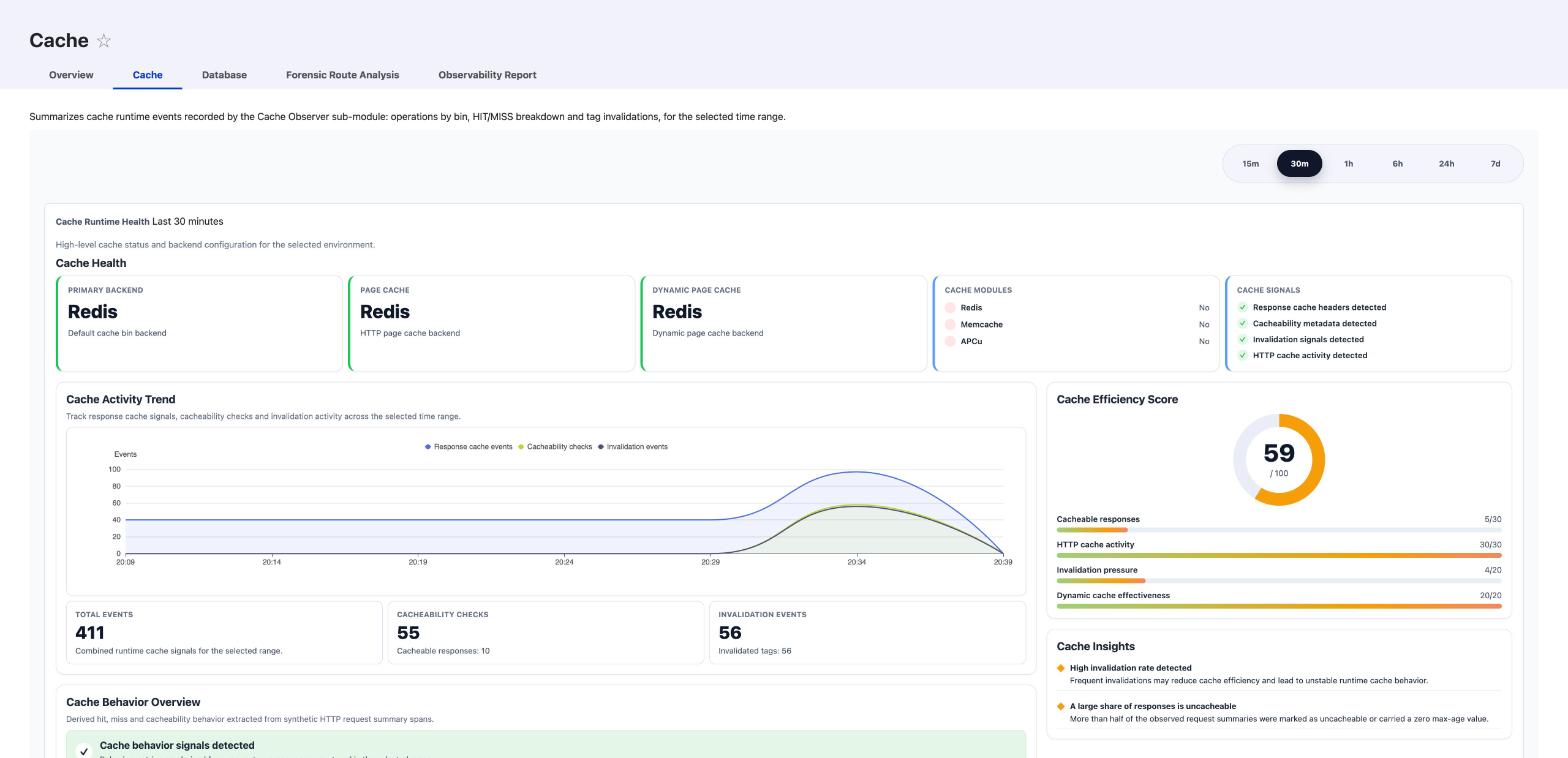
Routes
| Route | Path | Permission |
|---|---|---|
native_observability_cache_observer.report |
/admin/reports/native-observability/cache-observer |
access native observability cache observer |
native_observability_cache_observer.view |
/admin/reports/native-observability/cache-observer/{id} |
access native observability cache observer |
native_observability_cache_observer.export |
/admin/reports/native-observability/cache-observer/{id}/export |
access native observability cache observer |
native_observability_cache_observer.export_filtered |
/admin/reports/native-observability/cache-observer/export/filtered |
access native observability cache observer |
native_observability_cache_observer.delete_selected |
/admin/reports/native-observability/cache-observer/delete-selected |
administer native observability cache observer |
native_observability_cache_observer.delete_scope |
/admin/reports/native-observability/cache-observer/delete-scope |
administer native observability cache observer |
native_observability_cache_observer.delete_all |
/admin/reports/native-observability/cache-observer/delete-all |
administer native observability cache observer |
native_observability_cache_observer.delete_filtered |
/admin/reports/native-observability/cache-observer/delete-filtered |
administer native observability cache observer |
native_observability_cache_observer.settings |
/admin/config/development/native-observability/settings/cache-observer |
administer native observability cache observer |
Report
Open /admin/reports/native-observability/cache-observer. CacheObserverListController::list()
renders a filterable, paginated table (event/layer, status, method, route/path, request ID,
cacheability summary, created date) sourced from CacheObserverStorage. Filters read from the
query string: search, event_type, status, method (the filtered export and deletion forms
additionally support cache_layer, route_name, path, request_id, has_request_id, and
uncacheable_only).
If CacheObserverEnvironmentInspector detects a development/debug environment (for example page
cache or dynamic page cache disabled), the report shows a warning banner: in that condition, cache
headers, page cache hits, dynamic cache hits, and other observer signals may be partial or
missing.
Each row links to the single event view, and links to the correlated trace (via
native_observability.trace_view_by_request_id) when the row's request_id matches a stored
trace.
A row recorded for an Internal Page Cache HIT is the one case where that link is expected to be
absent. A hit is served by the page cache middleware before the HTTP kernel runs, so no trace row
is ever written for it. The observer still assigns the request a correlation ID and records it,
both on the row and on the X-Native-Observability-Request-Id response header, so a hit remains
identifiable and countable. That ID resolves to this cache event and to nothing in
native_observability_trace, which is the accurate answer for a request Drupal never handled.
Single event view
Follow a row's ID link, or open
/admin/reports/native-observability/cache-observer/{id} directly, for full details on one
captured cache event.
Exports
Single event
/admin/reports/native-observability/cache-observer/{id}/export downloads the raw stored record
as cache_observer_event_<id>.json.
Filtered set
/admin/reports/native-observability/cache-observer/export/filtered downloads up to 5000 rows
matching the current filter set as cache_observer_filtered_export.json. The payload includes a
meta block (export timestamp, row count, applied filters) alongside the rows array.
Deletion scopes
The submodule exposes four distinct deletion actions. They are not interchangeable: each targets a different subset of stored records.
| Scope | Route | What it deletes |
|---|---|---|
| Selected | delete_selected |
Only the record IDs passed in the ids query parameter (comma-separated), populated by row selection in the report UI. |
| Scope (table) | delete_scope |
Every record in one partition, chosen by the scope query parameter: route_bound (events captured inside a resolved Drupal route) or orphan (CLI, cron, install, or middleware events with no resolved route). The other partition is left untouched. |
| All | delete_all |
Every stored cache observer record, regardless of filters or partition. |
| Filtered | delete_filtered |
Only the records matching the filter set currently applied on the report page (up to 5000 rows per submission). |
flowchart TD
    A[Cache observer records] --> B[Selected: chosen row IDs only]
    A --> C["Scope: route_bound partition"]
    A --> D["Scope: orphan partition"]
    A --> E[Filtered: rows matching current filters]
    A --> F[All: every record]
All four deletion forms are confirmation forms and note explicitly that they remove stored observability records only; none of them clears Drupal's runtime caches.
Settings
/admin/config/development/native-observability/settings/cache-observer configures capture
behavior and retention. See
Cache observer settings for the full list of keys
and their default values.